

About two weeks ago I woke up on a Tuesday morning with a sharp pain in my left shoulder blade. Out of the blue. Like most of us, I ignored it, thinking age is not just a number (remember that from my previous post on age positive wellness)? The following day, the pain got so deep, it woke me up at 4 in the morning. Might as well stay up and research it online, I nodded to myself, and dove right into it.
Five days later, a hundred research articles on muscle inflammation, one quick phone call to my insurance and five excruciatingly painful physio manuals, I could just about twist my upper body without crying. On day six, it disappeared, as fast as it came, as if I had just woken up from a nasty nightmare, one of those that you want to run, but your legs won’t barge. That sudden on-offset, especially without any particular risky movement, made me think deeper about the cause of it. And then it dawned on me, it was a psychosomatic manifestation. I failed to recognise that it coincided exactly with extreme work-related stress, which led to bad sleep, which in turn irritated my gut, followed by uncontrollable craving for sugar, leading to mood swings, more stress, more agitated sleep … well you get the picture.
Why am I bothering with all that? Well, it inspired me to create a ‘macro-wellness framework’ – a way to think about health in a holistic way. You see, we’ve been talking about holistic health for many years now, we understand it conceptually, but what does it really mean from a practical perspective? What are the elements that need to come together to make health truly ‘wholistic’ and not just about random natural remedies? The word itself, after all, is derived from ‘holism’, the Greek word holos, meaning “whole.” It was coined by a South African soldier and statesman Jan Christian Smuts in the 1920s as a philosophical term to describe his complex philosophy regarding the organization of nature (and by definition of human beings) as “wholes”—that is, organisms made up of interdependent systems instead of distinct, independent molecules and atoms.
I’m diverging again with nerdy information. Back to the main point: we need a truly wholistic framework for health and wellness, so that we, everyday people, can better appreciate our bodies as an ecosystem. So that we can better understand the interdependency between different aspects of health, allowing us eventually to make better decisions about our health. Here’s how I approach it when I look at the well-being of my patients.
First, there are two simple dimensions that in my view encapsulate the ecosystem of a human being:
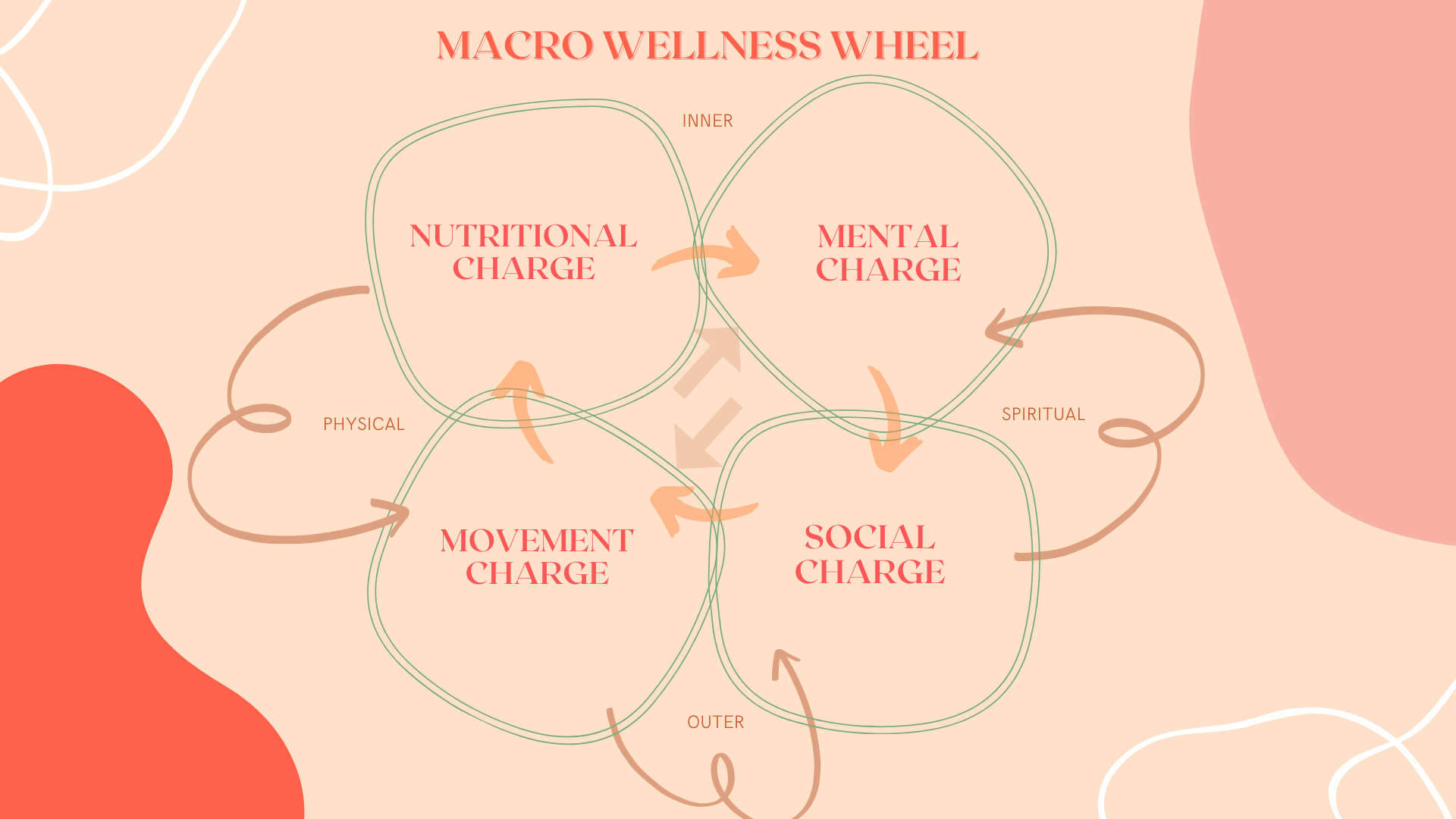
- The Physical vs. Spiritual dimension, describing the span from the tangible material body up to the subtleties and airiness of the spiritual world.
- The Inner vs. Outer world dimension, describing the influence we can have on our ecosystem deep from the inside or from the outside environment.
Plotting these two spectrums together we end up with 4 interdependent elements that become the foundation for living healthier, longer. See them as ‘charging points’ fueling your whole ecosystem (we are energy after all, down at the level of the peculiar quantum world). Forget to charge one of them and a problem will pop up in another. Look at a health problem only through the lens of one, and you might miss the true cause of the issue stemming from another. I call it, pretentiously, the Macro Wellness Wheel (see image at top).
Nutritional Charge: what you put or don’t put in your body, really matters. What you need to know:
- Food is medicine, the right micro-nutrients can help you cure problems, or enhance your overall well-being
- Food is medicine (take two), but it takes time and a lot more research is required in the field. Don’t be fooled by miracle-promising supplements.
- Food is personalised, generic diets don’t work.
Movement Charge: ‘everything flows’ is a fundamental law of the universe to which our physical body obeys to. What you need to know:
- All body systems, from the muscular and skeletal to the nervous and cardiovascular, operate at an optimal condition when there is continuous movement. Scientific fact, not theory.
- Study after study has shown that any physical activity, any, has a tremendously positive impact on both our physical and mental well-being.
- Movement is a physical characteristic of the regeneration process of very single cell in our bodies at a nano level; it is only natural that the more physical activity we do, the more we contribute to slowing down cellular degeneration.
Mental Charge: mental well-being is not about being perpetually happy; it’s about our mind having the resilience and dexterity to cope with everyday life. What you need to know:
- Stress is recognised by many as the No. 1 proxy killer disease today. The American Medical Association has noted that stress is the basic cause of more than 60 percent of all human illness and disease.
- Mindfulness (awareness and equanimity of the mind) is what food is to the body: mental medicine
- Positive outlook is scientifically proven to influence our health and wellness – Epigenetics is looking into the impact of our thoughts on
Social Charge: it is about how you perceive yourself against others, as much as it is about others and the connection towards you. What you need to know:
- Self-acceptance is the alpha and the omega of a healthy social and intimate life, or in the words of the world’s wisest drag queen ‘if you can’t love yourself, how the hell are you gonna love somebody else?’
- Your social environment, from work to relationships, has a direct and scientifically measured impact on your physical and mental state. If toxic, ditch it.
- Deep social connection and intimacy, physically through touch and emotionally through support networks, are fundamental to a healthy, happy life. They are usually underestimated in the role they play in physiological issues.
The first step to a successful Macro Wellness lifestyle is to embrace and appreciate the wholeness and interconnectedness of these four charges. Next time you think about a health problem (e.g IBS or sleep disturbances), or you want to improve your well-being (say, gut health), take the time -or better, ask your preferred expert working with you- to interrogate the situation through the lens of these four charging points. What you find might surprise you (and your GP might dismiss you!)
 Macro-Wellness