

Hi, my name is Yannis and I am a Mental Acuity Worrier. There, I’ve said it.
I’m freaking out. Am I alone worrying about my mental acuity as I age? The other day I was brainstorming with a couple of my colleagues about health related innovations in food and as I was trying to express the importance of natural ingredients, I froze: ‘they shouldn’t contain, you know, how do you call it, those ingredients that are bad for you, you know, er… the E numbers and all that’. You mean preservatives, snarled one of my younger colleagues with a heavy dose of irony.
I couldn’t remember the word preservatives! Brain freeze. Is this a sign of decline in my mental clarity and focus? Or should I just attribute it to my foreignness, English is my second language after all. Although, after 25 years, it should be my first, surely? It must be that. I always had the tendency to make up words and phrases as I was struggling to express myself. One of my directors, when I used to work in New York in the late 90s, told me she wanted to write a short book with ‘Yannisms’. She even had a title for it: ‘The Top of the Mountain’. Apparently it was hugely entertaining when one time I stumbled during a high-octane presentation to IBM and uttered ‘this is just to top of the mountain’, obviously wanted to say ‘the tip of the iceberg’, an expression that I knew pretty well, yet somehow my brain neurons wouldn’t make the connection.
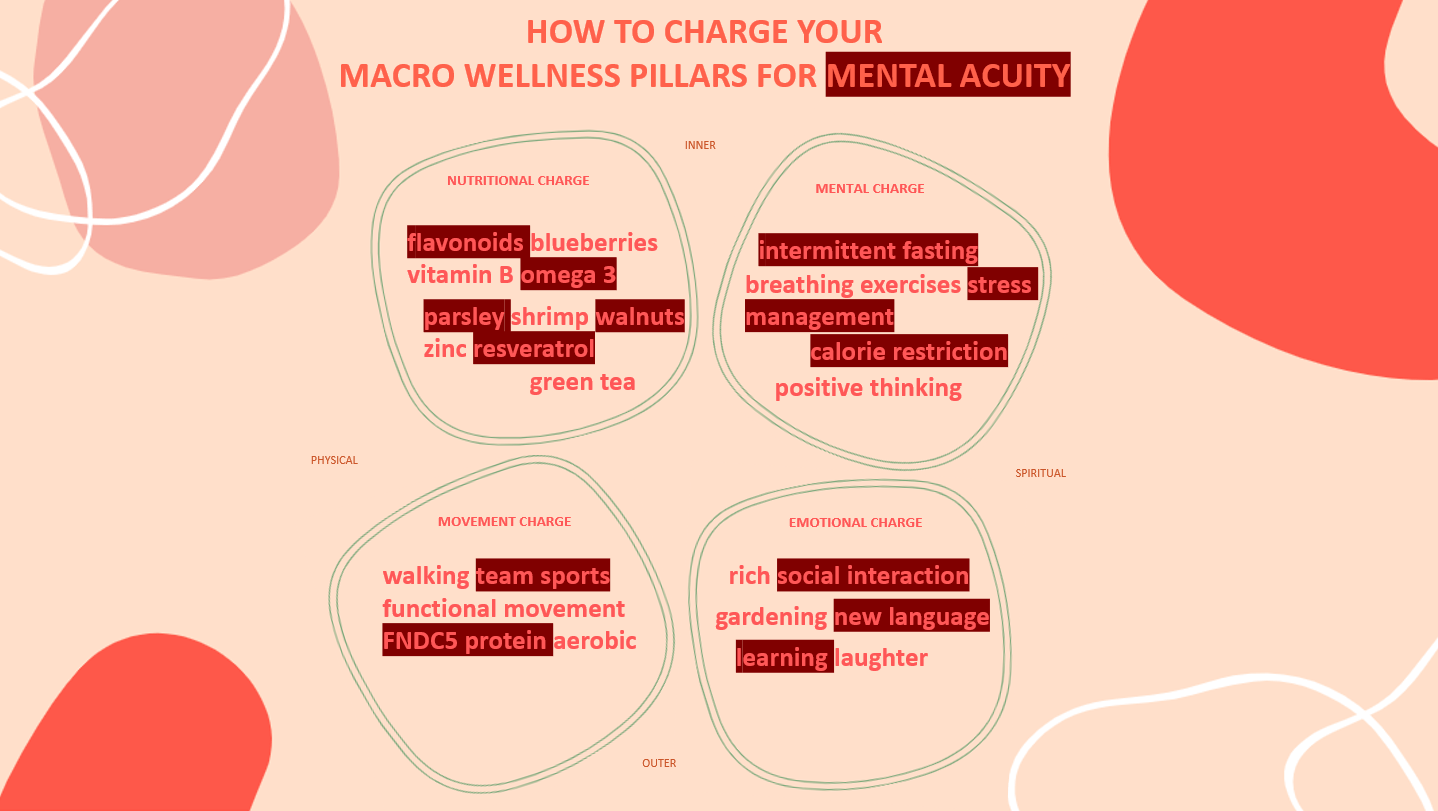
Guess what, I am not alone in this. Every knowledge worker whose career depends on thinking, has probably lost sleep over this at some point. We all face decline in cognitive performance, knowingly or not. It starts much younger than previously thought, after it reaches its peak in your early 20s and accelerates in your 40s. Although inevitable, this doesn’t mean that we’re powerless is slowing it down or even optimising it through a holistic lifestyle (until that Limitless pill is invented and it’s safe!). In fact, using the 4 pillars of Macro Wellness (Nutritional, Movement, Mental and Emotional Charge) you can specifically target two critical processes that support an optimal cognitive performance:
- Neuroplasticity, the ability of neural networks in the brain to change through growth and reorganization, with a special interest in BDNF gene (brain-derived neurotrophic factor), responsible for making a protein which promotes and protects the growth of nerve cells.
- Adult neurogenesis, a controversial view popularised recently by Dr Sadrine Thuret who claims that new cells can indeed be generated in adult humans, (although, opponents argue that evidence is still contradicting and more research is required.)
Here is how.
Nutritional Charge
What you put in your mouth plays a determinant role in every aspect of brain function. Let me spell it out for you: if your job depends on your brain (as it does for me), it depends on your diet.
- Brain loves antioxidant food, like vitamin A, vitamin C, and selenium. Flavonoids (a phytochemical found in many fruit and vegetables) are a must-have in your everyday diet. These antioxidants have a number of effects within the brain, including a potential to protect neurons against neurotoxins, suppress neuroinflammation, and promote memory, learning and cognitive function. They stimulate BDNF and protect your brain from stress. Coffee, green tea, dark chocolate, parsley, blueberries, and colorful vegetables are all excellent sources. Next time you use parsley just as a garnish you push aside, instead of packing your food with it, think again (my grandmother knew something)!
- Speaking of antioxidants, you probably have come across an Instagram popular compound called Resveratrol, due to its presence in red wine (lives on the skin of fruits like grapes and blueberries). It is thought to be a potent antioxidant and anti-inflammatory phytochemical, showing promise in protecting brain cells from damage. Little research has been done on humans though, so a Desperate Housewives attitude towards red wine is not an excuse.
- Brain loves good fat, it is the fattiest organ in our bodies, so eat more of it. Omega-3 fatty acids is a must-have in your everyday diet. Go for walnuts, flaxseeds and chia seeds if you’re vegan, or fatty fish if you’re a pescetarian (salmon, mackerel, bluefish, sardines, anchovies).
- Brain loves Vitamin B, like choline (a B vitamin needed to make memories), vitamin B6 and B12 (needed to support the nervous system), as well as minerals like iron and magnesium (needed for healthy blood and tissues). Choline spurs the creation and release of acetylcholine, a neurotransmitter that supports learning and memory. Choline also lowers inflammation in the brain. Best source is eggs and meat (sorry vegans) but also shrimps, broccoli, peas and navy beans.

Movement Charge
Yes, you know what’s coming. Exercise is not only good for our physical health but it benefits our mental abilities too. But did you know why? It’s not just about the general cardiovascular fitness that increases the much needed oxygen supply and blood flow to the brain. Physical exercise can affect how much of certain proteins are made in the brain. In particular, the levels of BDNF related protein increase after exercise. BDNF has already been shown to enhance mental abilities at the same time as acting against anxiety and depression in animal trials, nevertheless, it is currently not clear how exactly it does so.
In human trials, endurance (aka aerobic) exercise releases a protein called FNDC5 (fibronectin type III domain-containing protein 5 – how’s that for a mouthful?). FNDC5, in turn, increases BDNF by 200-300 percent.
Beyond your usual type of physical activity recommended here, such as running and walking, there are two the captured my attention, as they combine movement and actual thinking:
- Functional movement – think monkey bars, crawling through tunnels and balancing on beams at your nearest playground if you’re ok being starreddismissvely by toddlers and angry parents.
- Team sports – not only do you get a great aerobic exercise by running around, but you’re also working your brain in terms of tactics and quick thinking.
Mental Charge
Like any other body system, the brain needs training and a lot of TLC to be maintained at an optimal condition. Our neurons are like muscles — you can train them to become stronger and more efficient and you need to nurture them when under stress. I’m particularly intrigued with stress inducing techniques that test and stretch the brain’s resilience. For example:
- Depriving your brain of oxygen for a brief period triggers instant BDNF release. You can do this any time in under two minutes with simple breathing exercises like the Wim Hof method
- Scientists believe that new neural pathways increase by intermittent fasting and general calorie restrictions. Research has shown that fasting can help to clear the mind and awaken the senses while also boosting brain functioning.
Induced stress techniques are not to be confused with the silent killer of our times: chronic stress. It is a scientific fact that chronic stress ultimately also changes the chemicals in the brain which modulate cognition. Obviously a lot has been written about this, but here’s a different way to think about stress and mental performance. When you feel anxious or overwhelmed, your thoughts might be to blame too. According to cognitive behavioral therapy (CBT), negative thinking can also contribute to anxiety. Dr Joe Dispenza, known for his work on positive thinking, teaches people to challenge negative thoughts as they arise, and change them. Doing this actually rewires the brain — every time you think differently, you strengthen new neural pathways.
Emotional Charge
Nerve cells in the brain can also alter in response to social interaction. This plasticity is vital for the brain’s healthy function throughout life and staying social may be an important part of the jigsaw.
In fact, lack of meaningful social stimulation leads to lower BDNF levels. Social isolation contributes to depression, which decreases BDNF; I won’t be surprised at all if the current lockdown related depression issues expand to other mental health related problems such as sharpness and focus. As the old saying goes, spend time with friends and laugh a lot. The complex richness of social interaction challenges your brain and keeps it adaptable.
Last and potential the most under-appreciated tool in your brain boosting effort is learning new things. Challenging your brain with mental learning is believed to activate processes that help maintain individual brain cells and stimulate communication among them. Pursuing a hobby or learning a new skill are your brain-medicine. The more senses you use in learning something, the more of your brain will be stimulated. Neuroscientists have been preaching that “cells that fire together, wire together” since the late 1990s, meaning that if you perform a task or recall some information that causes different neurons to fire in concert, it strengthens the connections between those cells. Over time, these connections become thick, hardy road maps that link various parts of the brain — and stimulating one neuron in the sequence is more likely to trigger the next one to fire.
So, stop reading and…
- Pick up a new craft or hobby, like gardening or writing (like me!)
- Sign up to a class (of anything)
- Play a music instrument (even if badly)
- Learn a new language (handy for holidays)
Keep learning!
Select rabbit hole notes
- https://www.forbes.com/sites/jesscording/2018/03/12/top-brain-foods/?sh=3ea0e2d43a9d
- https://www.frontiersin.org/articles/10.3389/fncel.2019.00363/full
- https://elifesciences.org/articles/15092
- https://daveasprey.com/brain-health/
- https://daveasprey.com/increase-bdnf-brain-health/
- https://www.the-scientist.com/features/this-is-your-brain-on-exercise-64934
- https://exerciseright.com.au/brain-derived-neurotrophic-factor-bdnf-and-exercise/#:~:text=A%20bit%20of%20aerobic%20exercise,new%20networks%20with%20each%20other.
- https://www.ncbi.nlm.nih.gov/pmc/articles/PMC6246624/
- https://myhometouch.com/articles/social-interaction-and-brain-health
- https://www.health.harvard.edu/mind-and-mood/the-thinking-on-flavonoids
 Macro-Wellness