

Professionals, intellectuals and social sciences academics refer to Emotional Intelligence as the biggest educational deficit of our times. It is the crowning achievement of any great leader, be it at work or in personal life. They are probably right. A lot of the emphasis is placed on social relationships and the issues caused when people lack the ability to recognise and understand other people’s feelings. Or the confusion between empathy, a true appreciation of someone else’s context without necessarily sharing the same feeling, versus sympathy, where sharing common emotions is implied, sometimes crossing over to pity and commiseration, wrongly so. Messy stuff.
That’s only half of the story. I want to talk about intrapersonal emotional intelligence -aka looking inside to recognise and regulate your own feelings- and how this unlocks your resilience and improves your overall health and wellness. It is the foundation for a resilient body, mind and spirit and a way to optimise your daily vitality. It is one of the greatest tools to overcome chronic illnesses, like anxiety and stress. Its absence can lead to a distressed immune system, dissatisfaction and unhappiness. Recent studies have shown a positive relationship between markers of inflammation, stress or anxiety and negative emotional attention – also known as mindset, which related to intra-emotional intelligence. It took me several decades to learn to recognise my own feelings with nuanced, laser-sharp accuracy and pinpoint my physical health issues to a feeling of toxic shame, created in my early teenage years and eventually affecting my sense of self and mental wellbeing and causing chronic stress and inflammation. So let me share what I’ve learnt through many late nights of research, reading and practice.
Fact. Our brain constantly builds predictive models of every experience we have, or any experience it thinks we might have. According to Lisa Barrett, one of psychology’s wisest and most creative scientists, the simulations we create in our heads are more real to us than the physical world. Picture this. 11 year old boy’s mother says ‘you should be ashamed of yourself, you’ll end up being a faggot’ (I can use that word, you can’t, unless you’re gay). No big deal, but the seed of shame was planted. Fact. Once the neuropath is created, our brain will do anything it can to save energy by pulling up the same experience to reconstruct reality – regardless of what the actual events around us are. We might think that our perceptions of the world are driven by events in the world, but really, most of what we see is based on our internal predictions. Which means that initial negative experience of shame, or any emotion, eventually becomes a self-fulfilling prophecy; in my case, a prophecy of continuous anxiety, sense of rejection, obsession with perfection to avoid criticism and so forth (now you know all of my issues). Obviously, the opposite positive experience can happen. In essence, this is what having a ‘positive life outlook and mindset’ is all about. How on earth do you go about achieving it?
According to the Theory of Constructed Emotions, a good way to avoid being trapped in an emotional world of your own making, is developing the faculty of emotional granularity. In other words, having the ability to recognise the cause and label emotions in a nuanced way. The more aware and accurate we become with feelings, the earlier we can detect them and do something about it, instead of being the ones imprisoning ourselves. High emotional granularity gives us a variety of tools, allowing more flexible responses to regulate our anxiety, stress, and any other mental wellness challenges. Luckily, emotional granularity can be improved and can eventually lead to emotional regulation. In the true fashion of this blog, here are some simple techniques I use with my clients which you can try at home.
Name them to tame them
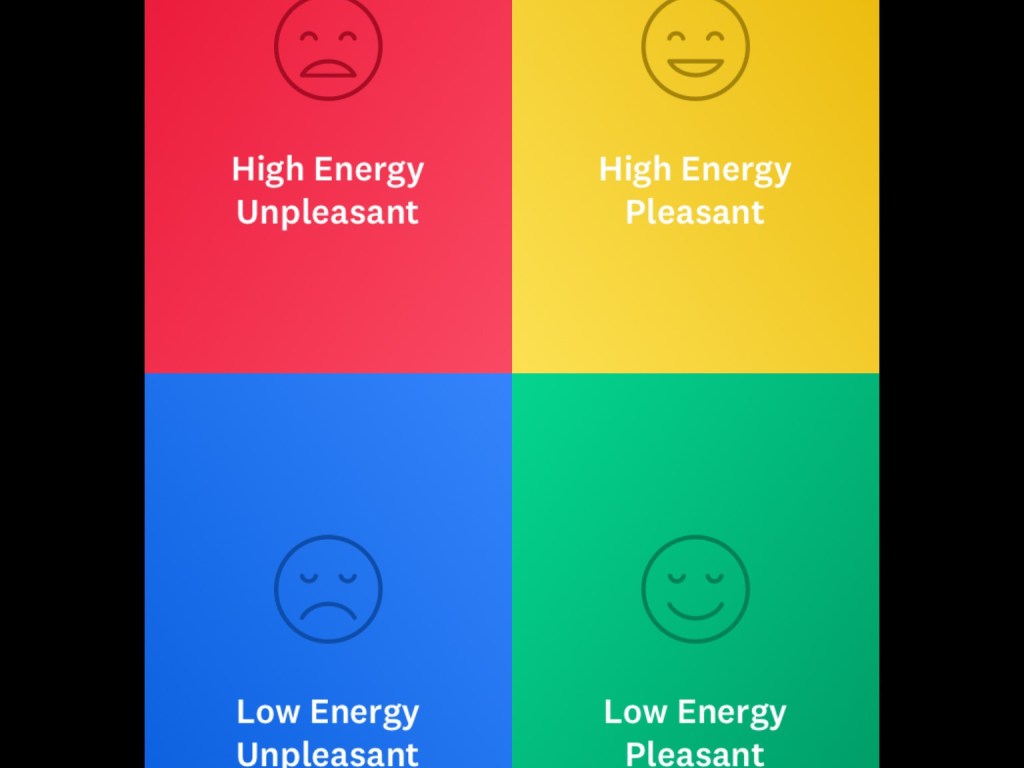
I can’t take credit for this wonderful expression. Professor Marc Brackett, the founding director of the Yale Center for Emotional Intelligence, has come up with it. He advocates the profound benefits of being better able to express and regulate our emotions on multiple aspects of our lives including our physical and mental health. He has developed something called the ‘RULER’ approach, which sets out the five underlying skills of emotional intelligence and stands for Recognising, Understanding, Labelling, Expressing and Regulating emotions. I started using the Mood Meter app to help me sharpen my language with emotions, both on myself and my client. It goes without saying that having a sharp mind, as taught in mediation techniques, is something you need to begin with.
Recategorize what you’re feeling
There are many techniques to do so. I like, promote and use myself Attitude Breathing. It’s very simple, yet extremely effective (aren’t most effective things simple?). It helps you replace draining, negative, emotions and attitudes with healthier positive ones.
- Step 1. Recognize a feeling that you want to change and identify a replacement attitude. For example, in my case, replace shame with acceptance or pride.
- Step 2. Focus your attention in the area of the heart. Imagine your breath is flowing in and out of your heart or chest area, breathing a little slower and deeper than usual. Suggestion: Inhale 5 seconds, exhale 5 seconds (or whatever rhythm is comfortable).
- Step 3. Breathe the feeling of the new attitude slowly and casually through your heart area. Repeat a few times, or until you start feeling a tingly sensation of happiness. Persevere.
Write about your emotions
I know what you’re thinking: here we go again, yet another blog talking about journaling. Well, get over it. It works. Writing is one of the most effective ways to directly shape what our brain is experiencing and, in turn, influence the volition of our emotions. Writing allows us to separate the ‘I’ from the ‘self’, observe our emotional world and make our thinking more concrete. It doesn’t matter when you do it, how or what you write. Just grab a pencil and a notebook and start writing. At the end of the week, go back, re-read and reflect. It’s guaranteed to make you feel better.
And who knows, you may end up starting your own blog. Happy practice!

Select rabbit holes notes and acknowledgements
- https://waiyancan.com/summary-connect-carole-robin-david-bradford/
- https://fortelabs.co/blog/how-emotions-are-made/
- https://waiyancan.com/seven-and-a-half-lessons-about-the-brain-by-lisa-feldman-barrett/
- https://6e3636b7-ad2f-4292-b910-faa23b9c20aa.filesusr.com/ugd/928487_70445cf40c2349a693d9081edaaa9f9e.pdf
- https://www.healthline.com/health/mental-health/toxic-shame
- https://lumenkind.co/blogs/news/tara
- https://waiyancan.com/seven-and-a-half-lessons-about-the-brain-by-lisa-feldman-barrett/#main
- https://fortelabs.co/blog/how-emotions-are-made/
- https://www.frontiersin.org/articles/10.3389/fnins.2019.00384/full
- https://self-compassion.org/wp-content/uploads/2018/05/Candea2018.pdf
 Macro-Wellness